Level: C1 Advanced
Focus: Speaking and Advanced Communication
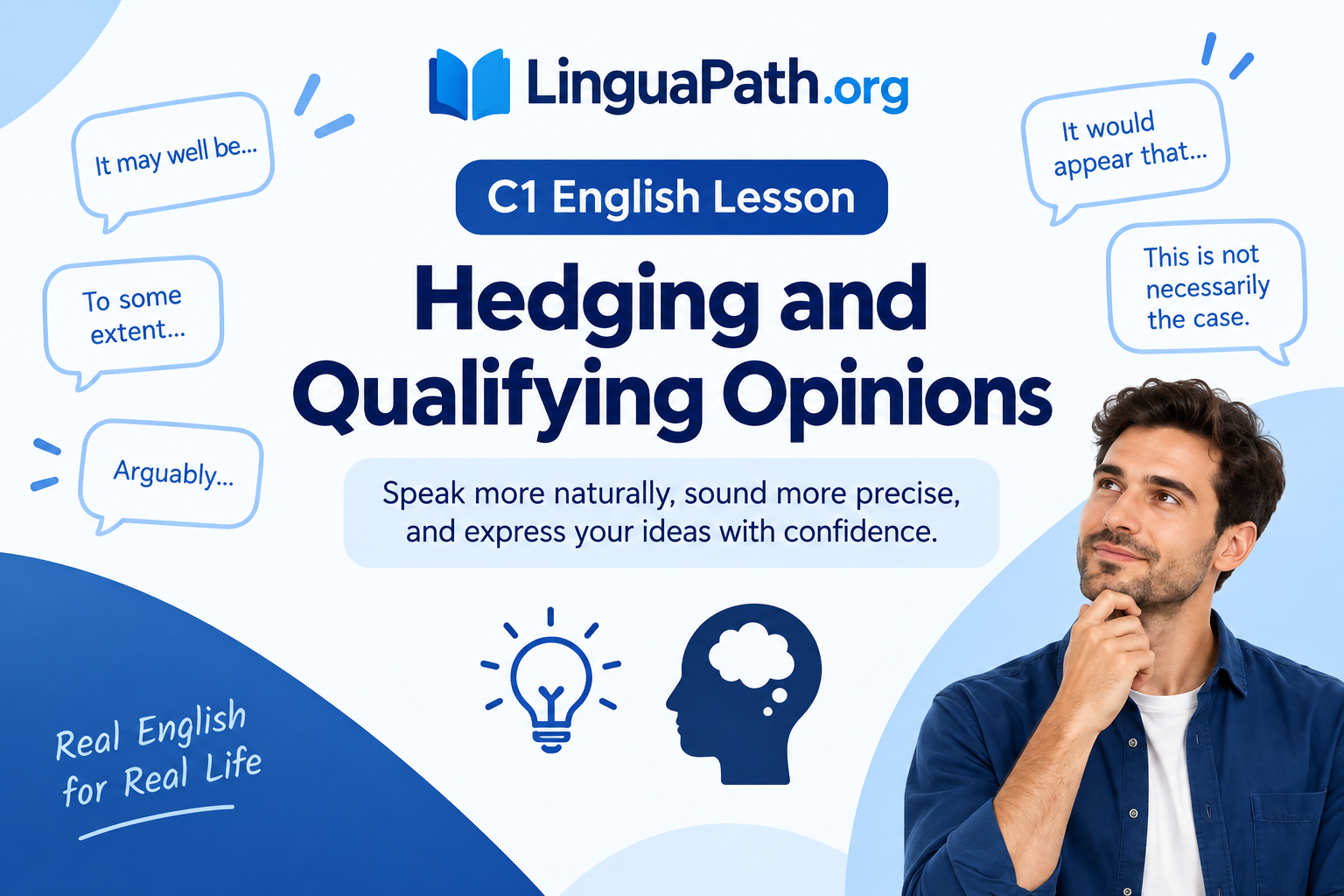
Topic: Hedging and Qualifying Statements
Author: Wadi Batyouk
Platform: LinguaPath.org
At C1 level, expressing an opinion is not only about saying whether you agree or disagree. Advanced speakers are expected to communicate complex ideas with precision and show how certain they are about a statement.
One important way to do this is through hedging. Hedging allows you to make a statement less absolute, acknowledge other possibilities, and sound more measured in academic, professional, and everyday discussions.
1. Why Do We Hedge?
Compare these two statements:
Social media damages communication.
Social media can, in some cases, have a negative effect on communication.
The second statement is more cautious. It leaves room for exceptions and avoids presenting a complex issue as an absolute fact.
2. Useful C1 Expressions
3. Qualifying a Generalisation
At C1 level, avoid making broad claims unless they can genuinely be supported. Qualifying language helps make your statements more accurate.
Too absolute:
People prefer working from home.
More precise:
Many people appear to prefer working from home, particularly when their role allows greater flexibility.
Too absolute:
Technology makes people less social.
More precise:
Technology may reduce face to face interaction in some contexts, although its effect depends largely on how it is used.
4. Short Discussion
Daniel: I think artificial intelligence will eventually replace most office jobs.
Michael: I am not sure I would go that far. It may well replace certain tasks, but that does not necessarily mean entire professions will disappear.
Daniel: Perhaps, but there seems to be a clear move towards greater automation.
Michael: I agree to some extent. However, I would argue that many roles are more likely to change than disappear completely.
Daniel: That is probably a fairer way of looking at it.
5. Strength of a Statement
Very strong:
This proves that the policy is ineffective.
More cautious:
This suggests that the policy may be ineffective.
More nuanced:
This would seem to suggest that the policy may be less effective than previously assumed.
As the language becomes more cautious, the speaker makes less absolute claims. This is especially useful when discussing evidence, research, trends, or controversial issues.
6. Mini Practice
Rewrite each statement so that it sounds more cautious and precise.
- Online education is better than classroom learning.
- Young people do not read books anymore.
- Working longer hours increases productivity.
- Social media causes loneliness.
- People only care about salary when choosing a job.
7. Speaking Practice
Discuss the following statements. Avoid giving completely absolute answers. Try to qualify your opinion and acknowledge other possibilities.
- University education is essential for professional success.
- Technology has improved the quality of human relationships.
- People are less patient than they were in the past.
- Remote work is better for employees.
- Artificial intelligence will fundamentally change education.
Example Answer
Statement:
University education is essential for professional success.
Answer:
I would agree to some extent, particularly in professions that require formal qualifications. However, this is not necessarily the case in every field. In areas such as technology or entrepreneurship, practical experience and specialist skills may be equally important.
Lesson Summary
In this lesson, you practised how to:
- make opinions less absolute
- express different degrees of certainty
- qualify broad generalisations
- acknowledge exceptions and alternative views
- communicate complex ideas with greater precision
Continue Learning C1 English
Develop advanced English for real communication with LinguaPath.
Explore further lessons in speaking, vocabulary, grammar, reading,
discussion skills, and sophisticated everyday English.
© LinguaPath. Created by Wadi Batyouk.
LinguaPath.org