LinguaPath
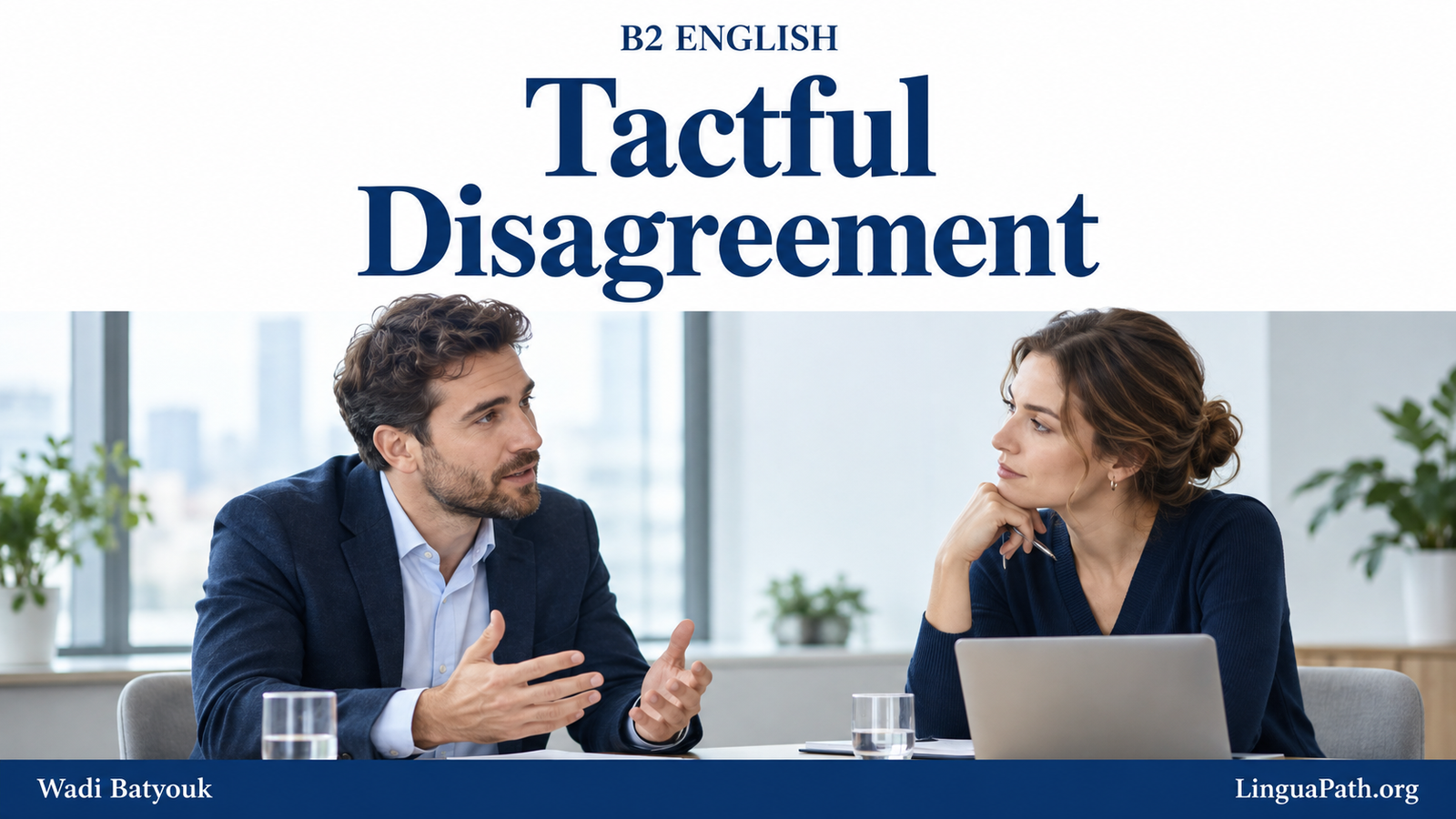
Tactful Disagreement
Discuss ideas, explain concerns and find common ground.
Level: B2 · Upper intermediate Focus: Speaking · Negotiation · Register
Learning goal: Challenge a proposal politely, support your view with reasons and negotiate a practical compromise.
01. Same concern, different effect
Your team has an idea. You can see a problem. How do you explain it clearly while keeping the discussion constructive?
Abrupt reply
“That won’t work. You haven’t thought about the guests.”
The criticism focuses on the person and gives no practical alternative.
Tactful reply
“I see your point, but some guests may not want to be filmed. Could we consider offering an audio option?”
The speaker recognises the idea, explains a concern and offers a solution.
Tactful means being careful about how you express something so that you avoid unnecessary offence. Your opinion can still be clear and firm.
02. Six expressions for constructive discussion
Expression 01
I see your point, but…
Function: Recognise someone’s reasoning before explaining a different view.
Example: “I see your point, but a lower price won’t help if the room is too small.”
Use: Understanding a point does not mean agreeing with it. Follow the phrase with a specific objection.
Expression 02
I’m not sure that would…
Function: Question a proposal without immediately rejecting it.
Example: “I’m not sure that would give the editor enough time to check the captions.”
Use: This often expresses a polite reservation about a proposed action. State what the problem would be.
Expression 03
My concern is that…
Function: Identify the possible consequence that matters to you.
Example: “My concern is that new members may find the booking process confusing.”
Use: Focus on an effect, a risk or a practical difficulty, rather than someone’s character.
Expression 04
That could work, as long as…
Function: Accept an option with a clear condition.
Example: “That could work, as long as we keep a few spaces for people who book later.”
Use: Here, as long as means only if. The condition is necessary for your agreement.
Expression 05
Could we consider…?
Function: Invite people to examine an alternative.
Example: “Could we consider extending the deadline by two days?”
Pattern: consider + noun or consider + -ing: “Could we consider a smaller venue?”
Expression 06
What if we…?
Function: Put forward a different possibility for discussion.
Example: “What if we tested the new layout with a small group first?”
Use: The past form in What if we tested…? makes this future suggestion less definite. It does not describe a past event.
03. Build the sentence accurately
1. Could + subject + base verb: “Could we try a shorter introduction?” Use the base form after could.
2. Consider + -ing: “Could we consider recording a shorter introduction?” When another verb follows consider in this pattern, use its -ing form.
3. As long as + present simple: “We can use the room tomorrow as long as we finish by six.” Use the present simple for this future condition.
4. What if + past simple: “What if we recorded a shorter introduction?” Here, the past form presents a tentative suggestion about what to do next.
05. A decision about the interview series
Amina and Theo are planning interviews with local residents. They need a format that works for the audience and the guests.
Amina
I think we should film every interview. Short video clips will be easier to promote.
Theo
I see your point, but some guests may not want to appear on camera.
Amina
We can explain that before they agree to take part.
Theo
That would help. My concern is that we’d still lose people with valuable stories.
Amina
What would you suggest?
Theo
Could we consider offering a choice between video and audio?
Amina
I’m not sure that would fit the format. We wanted every interview to look consistent.
Theo
What if we used the same opening graphic for both? That would give the series a consistent style.
Amina
That could work, as long as we tell viewers which interviews are audio recordings.
Theo
Agreed. Let’s test one of each before we record the full series.
Notice: Theo addresses Amina’s concern about a consistent style. Amina then sets a condition for accepting his alternative.
06. Choose, then rephrase
Choose the correct completion or interpretation. Each question has one answer.
- Could we consider ___ the workshop online?
A. moving B. to move - The plan could work, as long as we ___ written confirmation by Friday.
A. will receive B. receive - I’m not sure that would ___ everyone enough time.
A. give B. giving - My concern is ___ we don’t have a backup plan.
A. what B. that - “I see your point, but I think we need more evidence.” What does the speaker mean?
A. I understand your reasoning, but I have a different view.
B. I completely agree and have no concerns. - “That could work, as long as we test it first.” What is the speaker doing?
A. Rejecting the idea completely.
B. Accepting the possibility with a condition.
Answers
- A — moving. Use consider + -ing when suggesting an action.
- B — receive. Use the present simple for this future condition.
- A — give. The modal verb would is followed by the base form.
- B — that. That introduces the clause explaining the concern.
- A. Recognising someone’s reasoning does not necessarily mean agreeing.
- B. Testing the idea is a condition for accepting it.
Rewrite the reply
Keep the original concern, but make the reply more constructive. Add an alternative.
- “Your plan is unrealistic. We can’t finish everything in one day.”
- “No, we shouldn’t film everyone. Some people won’t want to be on camera.”
Possible answers
- “I’m not sure that would give us enough time. Could we consider splitting the work over two days?”
- “My concern is that some guests may feel uncomfortable being filmed. What if we gave them the option to record audio instead?”
Other answers are possible if they preserve the concern and offer a relevant alternative.
07. Negotiate an exhibition plan
Scenario: You and a partner are organising a neighbourhood photography exhibition. You need to agree on an opening time and a way to manage visitor numbers.
Role A
Reach people after work
You prefer Friday at 6 p.m. and advance booking for every visitor. The venue holds 40 people at a time.
Your concern: Too many people may arrive together.
Role B
Keep the event accessible
You prefer Saturday at 2 p.m. and some places for visitors without a booking. Families may find a late opening difficult.
Your concern: Booking should not be the only way to attend.
Your task: Discuss both proposals for two to three minutes. Use at least three expressions from the lesson. Explain one advantage and one disadvantage of each proposal, respond to your partner’s concern, and agree on an opening time and an entry arrangement.
Working alone? Record both roles, then listen again. Check that each speaker responds to the other person’s reason before proposing a compromise.
One possible negotiation
A: Friday evening would suit people who work during the day, but I can see that it might be difficult for families. I’d prefer advance booking because we only have space for 40 visitors.
B: I see your point, but Saturday afternoon would be easier for families. Some people may be working then, though. My concern is that requiring everyone to book could discourage people who decide to come at the last minute.
A: What if we opened on Saturday at four? We could offer arrival slots and keep ten places in each slot for visitors without a booking.
B: That could work, as long as we explain that people may have to wait when the room is full.
A: Agreed. We’ll open on Saturday at four, use arrival slots, and make the entry arrangements clear on the event page.
B: Yes, and we can post a few photos afterwards for anyone who can’t attend.
08. Keep the discussion moving
- Recognise the other person’s reasoning: “I see your point, but…”
- Make the concern specific: “My concern is that…”
- Offer an alternative: “Could we consider…?” or “What if we…?”
- Make a condition clear: “That could work, as long as…”
- Respond to the objection and agree on a practical next step.
Continue Learning B2 English
Visit LinguaPath for more English lessons and communication practice.