LinguaPath
A2 English Lesson · Speaking & Vocabulary
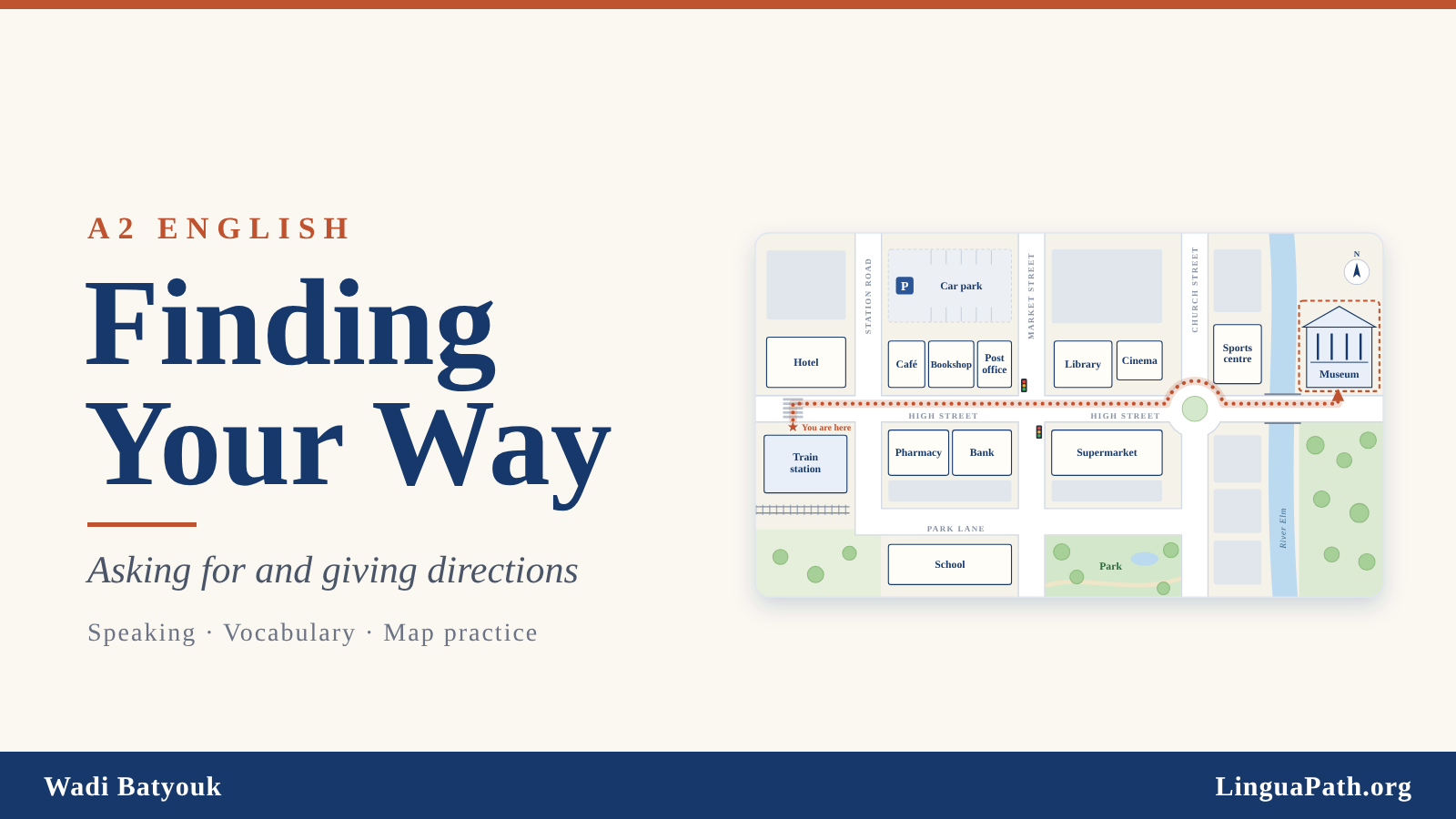
Finding Your Way
Ask for directions, understand the answer and help someone get exactly where they need to go.
By the end of this lesson, you can:
- ask for directions politely
- follow simple directions on a map
- give clear directions with first, then and after that
- say exactly where a place is
CEFR link: asking for and giving directions with a map or plan is an A2 skill (Council of Europe, 2020).
01Lost in a new town
You arrive in a town you don’t know. Your phone battery is dead, it’s starting to rain, and you need a pharmacy. The quickest solution? Ask someone.
Think and talk
- When did you last ask a stranger for directions? Where were you going?
- Do you prefer a map app or asking a person? Why?
- Think of a famous place in your town. How do you get there from your home?
Learning tip
Directions use the same small group of phrases again and again. Learn them as complete chunks, such as go straight on or take the second left, not word by word. You will understand faster, and you will speak more naturally.
02Asking the way politely
A good request has four simple parts. Choose one phrase from each card and you have a complete, polite conversation.
Step 1
Start politely
- Excuse me.
- Excuse me, can you help me?
- Sorry to bother you.
Step 2
Ask the question
- How do I get to the station?
- Where’s the nearest pharmacy?
- Is there a bank near here?
- Could you tell me the way to the museum?
Step 3
Check the details
- Is it far?
- Can I walk there?
- How long does it take on foot?
- Sorry, could you say that again?
Step 4
Say thank you
- Thank you very much.
- Thanks for your help!
- Reply: You’re welcome. / No problem.
Natural English
How do I get to…? is the most common way to ask. How can I go to…? is understandable, but it sounds less natural.
When there are many shops of the same kind, ask for the nearest one: Where’s the nearest pharmacy?
Don’t know the way? Say Sorry, I’m not from here. or Sorry, I don’t know this area.
Is there a… near here? uses there is. Review it in our lesson There is / There are.
03Giving directions: nine key phrases
Each picture shows a short walk. The blue dot is you, and the orange arrow is your route.
go straight onUK
Go straight on for about two minutes.
امشِ إلى الأمام مباشرةً
turn left
Turn left into Market Street.
انعطف يسارًا
turn right
Turn right after the bank.
انعطف يمينًا
take the second left
Take the second left. That’s Market Street.
خذ المنعطف الثاني على اليسار
go past
Go past the bank and keep walking.
تجاوز البنك
cross
Cross the road at the zebra crossing.
اعبر الشارع
at the traffic lights
At the traffic lights, turn right.
عند إشارات المرور
at the roundabout
At the roundabout, go straight on.
عند الدوّار
at the end of the road
Go to the end of the road and turn left.
في نهاية الشارع
British and American English
This lesson uses British English. American speakers often say go straight ahead instead of go straight on, and they count blocks: Go two blocks and turn left. You may also hear crosswalk (UK: zebra crossing) and traffic circle (UK: roundabout). More differences: British vs. American Vocabulary.
04Where exactly is it?
When you are close, say exactly where the place is. In each picture, the orange building is the place you are looking for.
next to
The café is next to the bookshop.
بجانب
opposite
The café is opposite the pharmacy.
مقابل
between … and …
The bookshop is between the café and the post office.
بين
on the corner of
The library is on the corner of High Street and Market Street.
عند زاوية
in front of
The bus stop is in front of the bank.
أمام
on your left / on your right
The café is on your left. The bank is on your right.
على يسارك / على يمينك
Opposite or in front of?
Many learners say in front of when they mean opposite. In English, they are different.
opposite = on the other side of the road, usually facing it (Oxford University Press, n.d.).
in front of = on the same side, near the front of the building.
✗ The café is in front of the pharmacy. (They are on different sides of the road.)
✓ The café is opposite the pharmacy.
✓ A taxi is waiting in front of the station.
05Grammar focus: short, clear instructions
Directions need very little grammar. Three patterns and a few small words will take you a long way.
AThe imperative
We usually give directions with the imperative: the base form of the verb, with no subject. In directions, this sounds clear and helpful, not rude.
| Form | Pattern | Examples |
|---|---|---|
| Positive | base verb + … | Turn left. Go past the bank. Cross the bridge. |
| Negative | Don’t + base verb + … | Don’t turn here. Don’t cross here; use the zebra crossing. |
| Relaxed alternative | you + present simple | You go along High Street, and then you turn right. |
BPut the steps in order
Sequence words help the listener follow you. Here is the way from the train station to the cinema:
- First, go along High Street.
- Then go past the post office.
- After that, go straight on at the traffic lights.
- Finally, look on your left. The cinema is just before the roundabout.
You can also use When you see / get to… to give a landmark: When you get to the roundabout, turn left.
CSmall words, big difference
Prepositions are tiny, but they change the meaning. Learn these combinations together:
DSay it clearly
Three words from this lesson that learners often find tricky. The big dot shows the stressed syllable.
●
straight
/streɪt/
The gh is silent. It sounds exactly like strait.
●••
opposite
/ˈɒpəzɪt/
OP-po-site: stress the first syllable.
•●•
museum
/mjuˈziːəm/
mu-SE-um: stress the second syllable.
06Welcome to Kingsley
Kingsley is an imaginary town. You are outside the train station, at the orange star. You will use this map in Sections 07 and 08: do each task first, then press a button to check the route.
Swipe sideways to see the whole map →
- You are here
- traffic lights
- zebra crossing
- roundabout
- route
07Read and follow: a visitor asks for help
Lina is visiting Kingsley for the first time. Outside the train station, she asks a local man, Tom, for help. Read the conversation and follow the route on the map with your finger.
LinaExcuse me. Can you help me? I’m looking for the museum.
TomOf course. Go along High Street, past the café and the post office.
LinaPast the post office. OK.
TomThen go straight on at the traffic lights. When you get to the roundabout, go straight on again.
LinaSorry, could you say that again, please?
TomNo problem. Straight on at the traffic lights, and straight on at the roundabout. After that, cross the bridge over the river. The museum is on your left.
LinaIs it far?
TomNot really. It’s about ten minutes on foot.
LinaGreat. Thank you very much!
TomYou’re welcome. Enjoy the museum!
Check your understanding. Choose the correct answer. Green means correct; red means try again.
1. What is Lina looking for?
Correct! She says, “I’m looking for the museum.”
Not quite. Look at Lina’s first line again.
2. What does Tom tell her to do at the traffic lights?
Correct! “Go straight on at the traffic lights.”
Not quite. Tom says the same thing for the traffic lights and the roundabout.
3. Lina doesn’t understand everything. What does she say?
Correct! This is a polite way to ask someone to repeat.
Not quite. Which question asks Tom to repeat his directions?
4. How long is the walk to the museum?
Correct! “It’s about ten minutes on foot.”
Not quite. Look at Tom’s answer to “Is it far?”
5. Where is the museum?
Correct! Now press Dialogue: museum on the map to see Lina’s route.
Not quite. Read Tom’s longest line again.
08Practice
Five short tasks, from understanding to accuracy. Answers are included, so you can study on your own.
AWhere are you?
Start at the star outside the train station each time. Read the directions, follow them on the map, and choose the place. Then press the matching route button on the map to check.
Route AGo along High Street and take the second left. It’s on the corner, on your right.
Correct! The first left is Station Road and the second left is Market Street. The library is on your right.
Not quite. Count the roads on your left: Station Road is the first, Market Street is the second.
Route BGo along High Street to the traffic lights and turn right. It’s on your left.
Correct! After you turn right, the supermarket is on your left and the bank is on your right.
Not quite. Turn right at the traffic lights, then look to your left.
Route CTake the first right into Station Road. Go to the end of the road and turn left. Go past the school and cross Market Street. It’s on your right.
Correct! You walk along Park Lane and go past the school. The park is after Market Street.
Not quite. You go past the school, so it isn’t the school. Keep walking and cross Market Street.
Route DGo along High Street. At the roundabout, turn left into Church Street. It’s on your right.
Correct! In Church Street, the sports centre is on your right. The cinema is on your left.
Not quite. You turn left at the roundabout, so you are walking north. What is on your right?
Route ECross High Street at the zebra crossing. It’s right in front of you.
Correct! The hotel is opposite the train station.
Not quite. Start at the star, cross the road and look straight ahead.
BChoose the correct word
Choose from each list. The box turns green when your answer is correct.
- Excuse me, how do I to the train station?
- left at the traffic lights.
- Take the right.
- The bank is the post office.
- The library is the corner of High Street and Market Street.
- Go the bookshop and the post office.
- cross the road here. It’s dangerous.
- Go to the of the road and turn left.
Show answers and explanations
- get: get to + place is the natural phrase. Reach has no to (reach the station), and we say arrive at.
- Turn: the imperative uses the base verb.
- second: use ordinal numbers: first, second, third.
- opposite: no to after opposite here. In front needs of.
- on: on the corner of two streets. (At the corner is also possible; in the corner is inside a room.)
- past: go past something. Pass is a verb: You pass the bookshop.
- Don’t: the negative imperative is Don’t + base verb.
- end: the end of the road.
CTrue or false?
Look at the map in Section 06. Are these sentences true or false?
1. The café is opposite the pharmacy.
Correct! They face each other across High Street.
Look again: the café and the pharmacy are on different sides of High Street, facing each other.
2. The post office is between the café and the bookshop.
Correct! The bookshop is between the café and the post office.
Look again: which building is in the middle?
3. The bank is next to the café.
Correct! The bank is next to the pharmacy, and it is opposite the post office.
Look again: the bank and the café are on different sides of the road.
4. The library is opposite the supermarket.
Correct! They face each other across High Street.
Look again at the corner of High Street and Market Street.
5. The museum is next to the sports centre.
Correct! The river is between them. You need to cross the bridge.
Look again: what is between the sports centre and the museum?
6. The hotel is opposite the train station.
Correct! Cross High Street at the zebra crossing and you are at the hotel.
Look again at the other side of High Street from the star.
DCorrect the mistakes
There is one mistake in each sentence. Find it, correct it, then check.
- Excuse me, where is the near bank?
- Go straight on and turn on right at the lights.
- The hotel is opposite to the train station.
- Take the three left. The school is on your right.
- The library is in the corner of High Street and Market Street.
- Cross the bridge, and the museum is in your left.
Show the corrections
- Excuse me, where is the nearest bank?
- Go straight on and turn right at the lights.
- The hotel is opposite the train station.
- Take the third left. The school is on your right.
- The library is on the corner of High Street and Market Street.
- Cross the bridge, and the museum is on your left.
EPut the conversation in order
Someone asks for a pharmacy. Write the letters in the correct order (1–6), then check.
- aYou’re welcome. Have a nice day!
- bExcuse me, is there a pharmacy near here?
- cThank you so much!
- dYes, there is. Go along this street and take the first right. It’s next to the bank.
- eNext to the bank. OK. Is it far?
- fNo, it’s only about five minutes on foot.
Show the correct order
1 b → 2 d → 3 e → 4 f → 5 c → 6 a
Notice how the speaker in e repeats the key information (Next to the bank.) to check it. This is a simple and natural way to show that you understand.
09Your turn
Now use the language yourself, first in speaking and then in writing.
ARole-play: at the train station
Work with a partner and use the map. Studying alone? Say both parts aloud.
Round 1 · Student A asks
You are a visitor at the train station. Ask the way to:
- the bookshop
- the school
- the car park
Remember to check details: Is it far?
Round 2 · Student B asks
Change roles. Now you are the visitor. Ask the way to:
- the pharmacy
- the cinema
- the sports centre
Repeat key information to check: So, on my left?
If you don’t understand
Sorry, could you say that again? · Could you speak more slowly, please? · So, I turn left at the traffic lights. Is that right?
Learn more phrases like these in Asking for Clarification.
Show possible answers
- Bookshop: Go along High Street and go past the café. The bookshop is on your left, between the café and the post office.
- School: Take the first right into Station Road. Go to the end of the road and turn left into Park Lane. The school is on your right.
- Car park: Go along High Street and take the first left into Station Road. The car park is on your right.
- Pharmacy: Go along High Street and cross Station Road. The pharmacy is on your right, opposite the café.
- Cinema: Go along High Street and go straight on at the traffic lights. The cinema is on your left, just before the roundabout.
- Sports centre: Go along High Street to the roundabout. Turn left into Church Street. The sports centre is on your right.
BWrite a message
Your friend Sara is coming to visit you. She will arrive at Kingsley train station. Your flat is above the bookshop. Write her a message (40–60 words) and explain how to get there.
Include:
- First, Then and After that
- at least one phrase from Section 04 (next to, opposite, between…)
- a friendly ending
Show a model answer
Hi Sara! First, come out of the train station and cross High Street at the zebra crossing. Then turn right and walk along High Street. After that, cross Station Road and go past the café. My flat is above the bookshop, between the café and the post office. Ring the bell and I’ll come down. See you soon! Amina
(59 words) Follow the model on the map. Every step leads to the bookshop.
10Lesson summary
Keep this phrase bank. It covers almost every conversation about directions at A2 level.
Ask
- Excuse me, how do I get to…?
- Where’s the nearest…?
- Is there a… near here?
- Is it far?
- Sorry, could you say that again?
Give directions
- Go straight on. / Go along…
- Turn left / right (into…).
- Take the first / second left.
- Go past… / Cross…
- At the traffic lights / roundabout…
- Go to the end of the road.
Say where
- next to
- opposite
- between… and…
- on the corner of…
- in front of
- on your left / on your right
Check your progress
Tick the sentences that are true for you.
Teaching this lesson in class?
- Information gap: print the map twice. Remove three labels from Student A’s copy and three different labels from Student B’s. Students ask for directions to find the missing places.
- Real places: ask learners to give directions from your school to a café, a station or a famous place nearby.
- Listening: read one route aloud, slowly and clearly. Learners follow it on the map and say where they are.
Continue learning
References
Council of Europe. (2020). Common European Framework of Reference for Languages: Learning, teaching, assessment – Companion volume. Council of Europe Publishing. https://www.coe.int/lang-cefr
Oxford University Press. (n.d.). Opposite. In Oxford Advanced Learner’s Dictionary. Retrieved November 8, 2026, from https://www.oxfordlearnersdictionaries.com/definition/english/opposite_3
LinguaPath · A2 English · Finding Your Way